
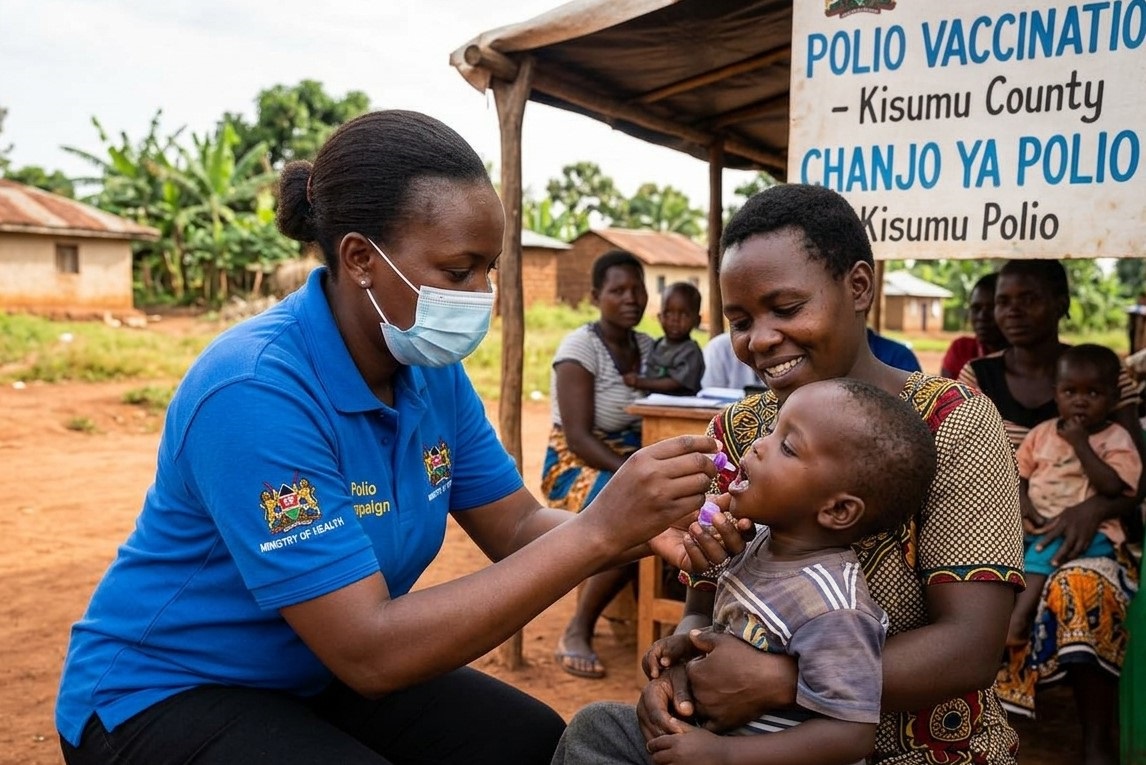
Kenya has reported no poliovirus cases since July 2024, but health authorities are maintaining surveillance as neighbouring countries continue to battle the risk of the virus spreading across borders.
The latest data from the World Health Organization (WHO) shows that Kenya investigated 598 suspected polio cases in 2025, with the country continuing to strengthen its ability to detect the virus before it can spread.
The surveillance effort has also expanded beyond health facilities. Kenya increased its environmental surveillance network from 21 to 24 sites across eight counties, where wastewater is tested for signs of poliovirus. Three counties such as Bungoma, Busia and Nakuru were added to the network in 2025.
The developments come as WHO announced that five African countries, Burundi, Ghana, Guinea-Bissau, the Republic of Congo and Uganda, have successfully stopped transmission of poliovirus type 2 outbreaks following independent assessments conducted between January and June 2026.
“These outbreak closures demonstrate what can be achieved through strong national leadership, dedicated health workers and close collaboration between governments, communities and partners,” said Mohamed Janabi, WHO Regional Director for Africa.
Janabi, however, warned that the progress should not lead to complacency rather there should be more surveillance.
“While this is an important milestone, it is not the end of the journey. Continued vigilance, strong surveillance and high immunization coverage remain essential to protect children and prevent future outbreaks,” he added.
For Kenya, the concern is partly linked to its position in the Horn of Africa, where movement of people across porous borders continues to create a risk of poliovirus importation.
At a regional meeting in May 2026, WHO said the Horn of Africa and Yemen remained one of the world’s most challenging polio epidemiological areas because of population movement, humanitarian crises, insecurity and gaps in immunity. Kenya was among the countries that reaffirmed its commitment to stronger cross-border surveillance and coordinated vaccination efforts.
Kenya’s recent progress has therefore been accompanied by efforts to improve how quickly the virus can be detected. In 2025, the country upgraded its national polio laboratory at the Kenya Medical Research Institute (KEMRI), allowing genomic sequencing of poliovirus locally. WHO said the upgrade has helped reduce the time taken to process samples and trace how viruses are spreading.
Environmental surveillance has also proved important. WHO reported that in 2024, Kenya recorded five confirmed variant poliovirus cases and all were first detected through environmental sampling.
Kenya has also used vaccination campaigns to close immunity gaps in high-risk areas. In early 2025, more than 1.76 million children under five in Mandera, Marsabit, Wajir and Garissa were reached during a two-round polio vaccination campaign, with reported coverage of 109.9 percent.
The experience of the five countries whose outbreaks have now been closed shows why Kenya cannot afford to scale back these measures.
WHO stated that the countries achieved progress through rapid detection, strong surveillance, community engagement and quality vaccination campaigns. It also warned that the recent detection of poliovirus in Madagascar after a previous outbreak closure shows that countries can remain vulnerable even after transmission has been interrupted.
“These outbreak closures demonstrate what can be achieved through strong national leadership, dedicated health workers and close collaboration between governments, communities and partners”
— Mohamed Janabi, WHO Regional Director for Africa